
Description
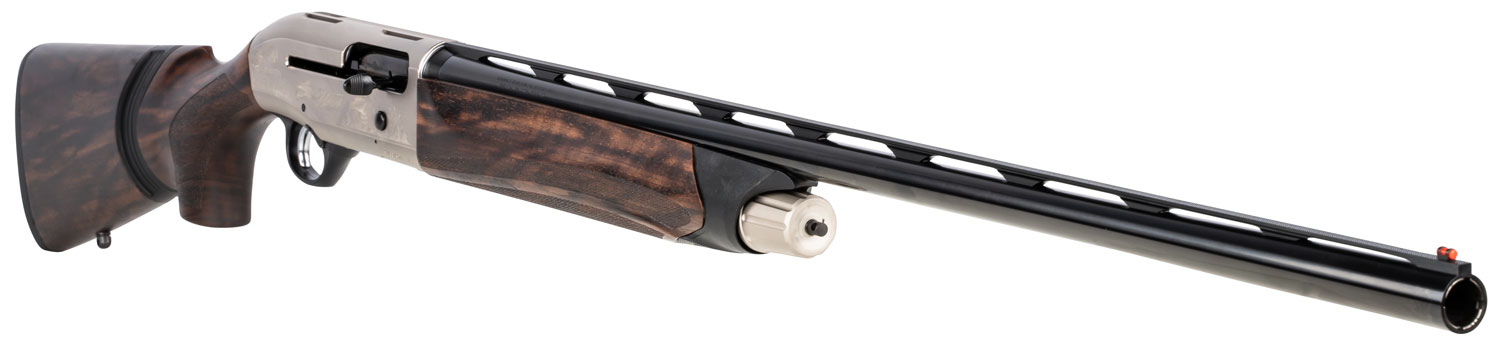
The Beretta A400 Upland in 20 gauge with a 28 inch barrel is the version for open country. The extra two inches over the 26 inch gun add a little weight out front, and on a light 20 gauge that weight is exactly what a shooter needs to keep the swing moving through a crossing bird instead of stopping at the trigger pull.
Part number J40AN28 carries a 3 inch chamber, a two round magazine, a nickel engraved receiver, and an Xtra Grain walnut stock fitted with Beretta’s Kick-Off recoil reduction.
The case for a longer barrel on a small bore
Short barrels get recommended for 20 gauges on the theory that a small bore should be a light, quick gun. That is right for grouse woods and wrong almost everywhere else. A 20 gauge is already light; the problem most shooters have with one is stopping the swing, not starting it. Twenty-eight inches fixes that without turning the gun into a burden.
The longer sighting plane helps too. On a going-away bird, a longer distance between eye and bead makes small alignment errors easier to see and correct. Most shooters who try both lengths on clays find they break more targets with the 28.
Blink gas system, Steelium barrel, Kick-Off stock
The Blink gas system cycles faster than competing designs, runs a self-cleaning piston, and vents excess pressure so 2 3/4 inch target loads and 3 inch hunting shells both work without adjustment. On a light gun the gas action also absorbs a real share of the recoil impulse before it ever reaches the shoulder.
The barrel is Steelium, Beretta’s cold hammer forged and vacuum distended tri-alloy, cut with the Optima-Bore HP profile and an extended forcing cone that treats the shot column gently. Three OptimaChoke HP tubes come with the gun. Inside the buttstock, Kick-Off hydraulic dampers take the edge off the heavier loads.
Specifications
- Model: Beretta A400 Upland, part number J40AN28
- Gauge: 20
- Chamber: 3 inches
- Capacity: 2+1 rounds
- Barrel length: 28 inches, Steelium with a ventilated rib
- Bore: Optima-Bore HP with an extended forcing cone
- Chokes: three OptimaChoke HP tubes
- Action: semi-automatic, Blink gas system with a self-cleaning piston
- Receiver: nickel finished, engraved
- Stock: Xtra Grain walnut with Kick-Off recoil reduction
- Hand: right
Why it is worth considering
- Enough barrel to keep the swing honest, without the weight of a 12 gauge.
- Gas operation and hydraulic stock dampers, which together make 3 inch loads genuinely comfortable.
- A longer sighting plane that helps on going-away and crossing birds alike.
- Steelium barrel with Optima-Bore HP geometry and three choke tubes included.
- The same nickel engraved receiver and figured walnut as the 12 gauge guns.
Who it suits
This suits the hunter who works open fields and field edges, shoots doves over cut corn, and wants one light gun that also handles a round of sporting clays. It is a strong choice for a shooter stepping up from a youth gun, and for anyone who has decided that carrying a 12 gauge all day is no longer worth the extra payload.
Hunters who spend their season in thick grouse and woodcock cover will be better served by the 26 inch build, and anyone who needs reach on late-season roosters in open country should stay with a 12 gauge.

Shells, chokes, and transfer notes
Shotshell dimensions and pressures are standardized by SAAMI, and the 3 inch chamber accepts both 2 3/4 and 3 inch 20 gauge shells. For upland hunting we stock 1 ounce number 5 pheasant loads; for clays and dove work the 7/8 ounce 7.5 shot target load keeps practice affordable. Steel shot is fine through improved cylinder and modified OptimaChoke HP tubes, never through a full choke.
Hunters working tight cover should compare the faster-handling 26 inch 20 gauge, and anyone who wants more payload for open-country birds should look at the 28 inch 12 gauge. Every long gun we sell ships to a licensed FFL for transfer and background check, and Pennsylvania buyers should plan on the state point of contact check at pickup.


Reviews
There are no reviews yet.