
Description
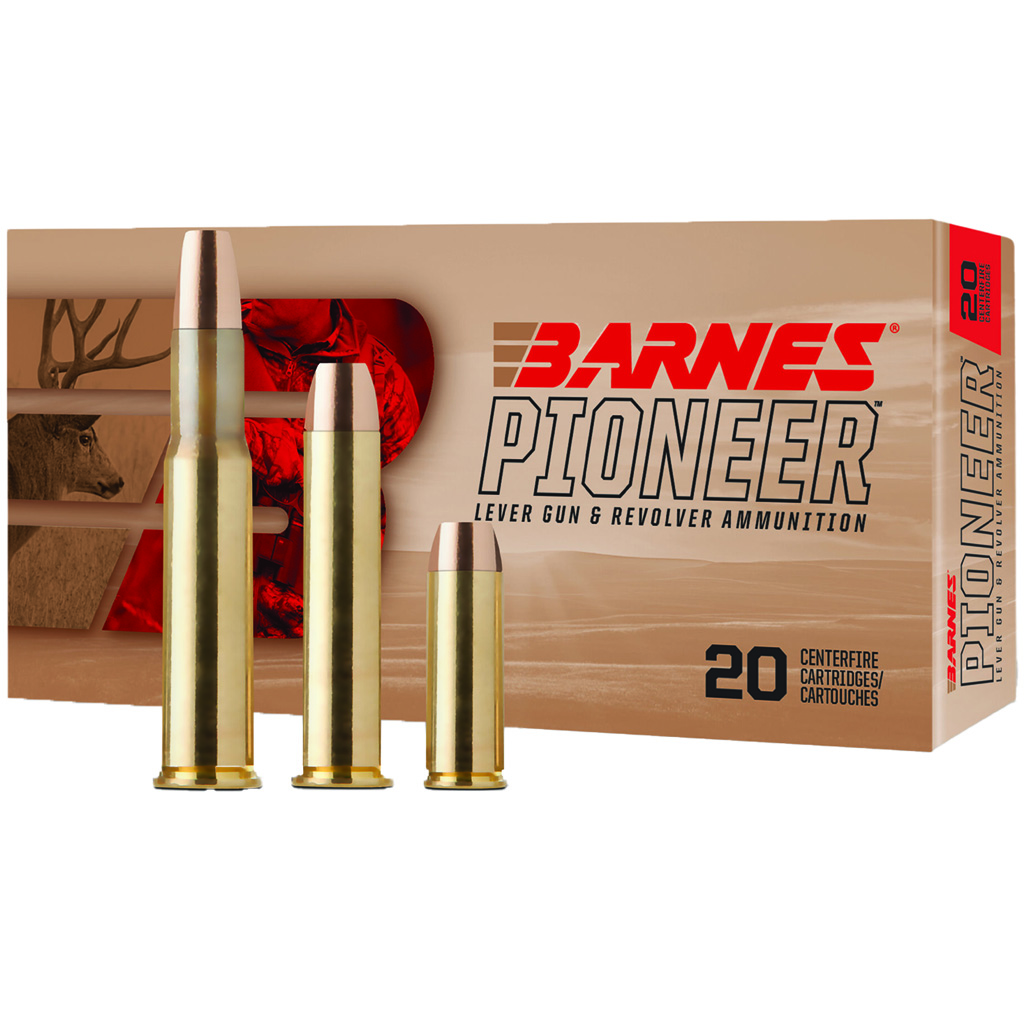
Barnes Pioneer 357 Mag 180gr is the heavy specialist in the .357 lineup, and it uses a completely different bullet from the 140 grain copper load alongside it. The Barnes Original is a thick-jacketed lead-core design from long before the company’s monolithic era, and it is here for one reason: penetration.
Heavy Bullet, Thick Jacket
The .357 Magnum usually runs 125 to 158 grain bullets. At 180 grains you are at the top end of what the cartridge carries, and the velocity drops accordingly. What you gain is momentum and sectional density, which is what drives a bullet through heavy muscle and bone rather than stopping in it.
The Barnes Original in Barnes Pioneer 357 Mag 180gr adds an unusually heavy jacket. Where a standard hollow point opens fast and can shed its core, this design expands slowly and holds together, which is exactly the behaviour you want from a heavy 357 Magnum load aimed at larger animals or difficult angles.
The combination makes this a genuine hunting and backcountry load rather than a defensive one. It is the kind of round people carry in a revolver in hog country or in the woods where a large animal at close range is a real possibility.
Barnes Pioneer 357 Mag 180gr Specifications
Barnes Pioneer 357 Mag 180gr is a 180 grain load with the Barnes Original in a flat nose profile, 20 rounds to the box, from Barnes Bullets. The Pioneer line covers revolver and lever gun ammunition, and the 180 grain flat nose bullet profile is safe in a tubular magazine as well as a cylinder.
Barnes Pioneer 357 Mag 180gr uses a lead-core bullet rather than a monolithic copper one, and that is the right choice for this role. The Barnes Original reaches its penetration through jacket thickness and weight instead of being made from a single metal, which also keeps the price below the copper offerings.
If you shoot a .357 lever carbine, expect a substantial velocity increase over a revolver, often several hundred feet per second. With a heavy bullet that translates into meaningfully more energy on target, and the thick jacket handles the higher impact velocity without coming apart.
- Caliber: .357 Magnum
- Bullet weight: 180 grain
- Bullet type: Barnes Original, flat nose
- Construction: lead core, thick copper jacket
- Profile: safe for tubular magazines
- Suitable platforms: revolvers and lever carbines
- Rounds per box: 20
- Manufacturer: Barnes Bullets
- Product line: Pioneer
Recoil, Trajectory and What It Is Not
Recoil from Barnes Pioneer 357 Mag 180gr is noticeably stiffer than a standard 158 grain load, particularly in a lightweight revolver. In a steel-framed gun with a four inch barrel it is manageable. In an alloy-framed carry revolver it is genuinely unpleasant and you will not shoot it well. Match the load to the gun.
Trajectory is steep. A heavy, slow bullet drops fast, and a fifty yard zero is a sensible starting point for revolver work. If you shoot it in a carbine you gain enough velocity to stretch that somewhat, but this is still a close range proposition.
Barnes Pioneer 357 Mag 180gr is not a defensive load and should not be treated as one. A slow-expanding thick-jacketed bullet will overpenetrate badly on a human-sized target, and the whole design intent runs opposite to what defensive ammunition is meant to do. For carry, a proper defensive hollow point is the correct choice.
Hunters and backcountry carriers who want Barnes Pioneer 357 Mag 180gr in a .357 revolver or lever carbine who need deep penetration on hogs, black bear or heavy-bodied game.
For a lighter, lead free option in the same cartridge, the Pioneer 357 Mag 140gr TSX is the all copper choice, and if you want more cartridge entirely the Pioneer 44 Mag 300gr JHP is the step up. A Taurus 66 Combat is a steel-framed revolver that handles heavy loads without punishing you.
Store Barnes Pioneer 357 Mag 180gr indoors and dry, and avoid repeatedly cycling the same rounds through a chamber. Straight wall cases let a bullet set back under repeated handling, and in a cartridge that already runs at high pressure that is worth avoiding.
One more thing worth knowing about heavy .357 loads generally. Cylinder throat and forcing cone dimensions vary between revolvers more than most shooters realise, and a long heavy bullet is more sensitive to that variation than a short light one. If your revolver shoots standard 158 grain ammunition well but groups this poorly, the bullet is not at fault and neither are you. Some guns simply prefer certain bullet lengths, and the only way to find out is to shoot a box at paper and look at the result.
Reviews
There are no reviews yet.