Description
Barnes Pioneer 30-30 Win 150gr TSX applies modern bullet technology to the oldest smokeless deer cartridge in America. The .30-30 Winchester has been loaded with cup-and-core soft points since 1895, and an all copper Triple Shock X is a genuine change in what the cartridge can do.
Modern Bullet, Old Cartridge
The traditional .30-30 load is a 150 or 170 grain flat nose soft point, and it has killed an enormous number of deer. Its limitation is construction: a lead core in a thin jacket expands fast and can shed weight, which at .30-30 velocities sometimes means shallow penetration on a big animal or a bad angle.
The all copper flat nose bullet in Barnes Pioneer 30-30 Win 150gr TSX removes that failure mode. There is no core to separate because the bullet is one piece of copper. The TSX opens into four petals on impact and typically retains close to its full weight, so a 150 grain projectile penetrates like something considerably heavier.
The flat nose profile is not a stylistic choice. In a tubular magazine, each cartridge rests its bullet tip against the primer of the round ahead. A pointed bullet in that position is a genuine hazard under recoil, which is why every .30-30 load is flat or round nosed and why polymer-tipped lever ammunition uses soft flexible tips.
Barnes Pioneer 30-30 Win 150gr TSX Specifications
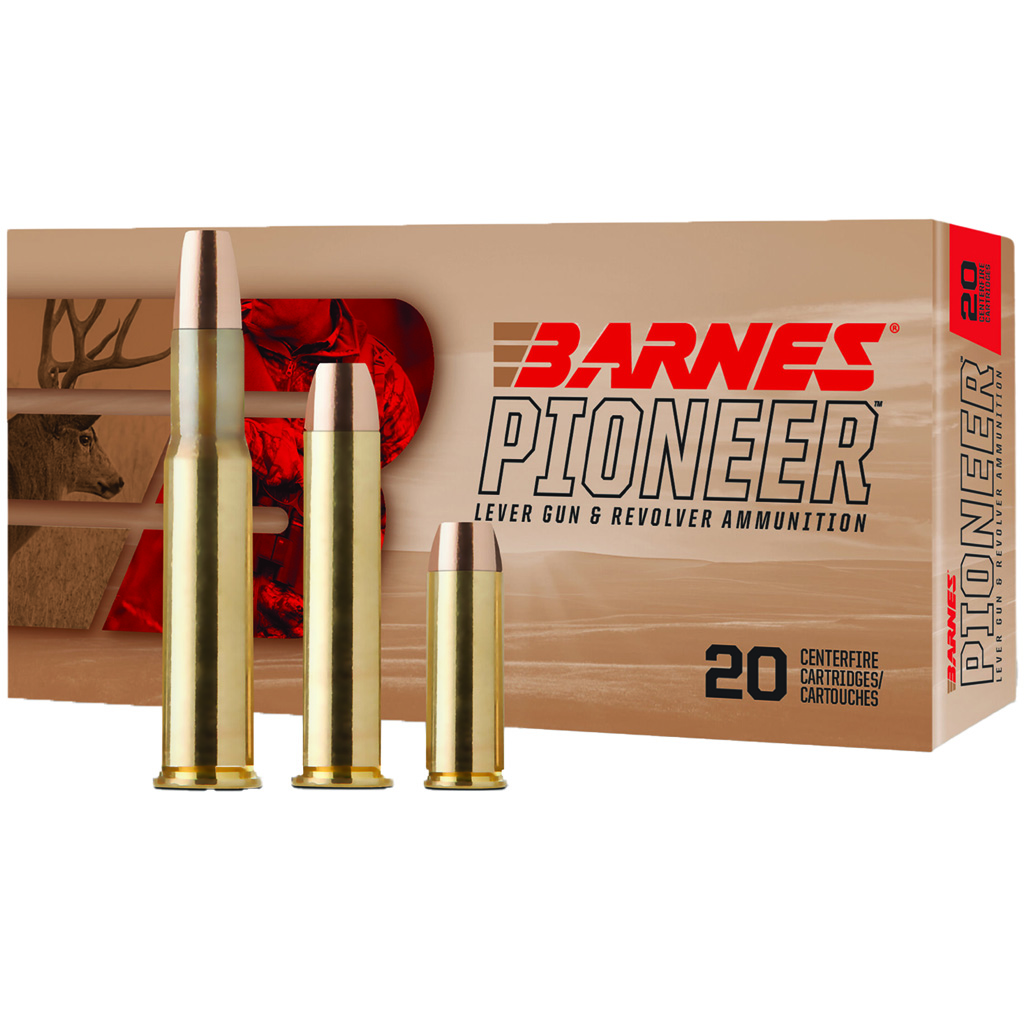
Barnes Pioneer 30-30 Win 150gr TSX is a 150 grain load using the Barnes TSX flat nose, 20 rounds to the box, from Barnes Bullets. The Pioneer line is the company’s lever gun and revolver ammunition, built around profiles that feed and rest safely in tubular magazines.
Because the bullet is solid copper, Barnes Pioneer 30-30 Win 150gr TSX is a lead free lever action load, which matters in California and the expanding list of federal refuges and state units requiring non-lead ammunition. The .30-30 remains extremely popular in exactly the kind of small-parcel, close-cover hunting those rules often cover.
One hundred and fifty grains is the lighter of the two traditional .30-30 weights and shoots slightly flatter than a 170. With a copper bullet that retains its weight, the usual reason to prefer 170 grains for penetration largely disappears, which makes 150 the more sensible default here.
- Caliber: .30-30 Winchester
- Bullet weight: 150 grain
- Bullet type: Barnes TSX flat nose
- Construction: all copper
- Profile: safe for tubular magazines
- Lead free: yes
- Rounds per box: 20
- Manufacturer: Barnes Bullets
- Product line: Pioneer
Range, Accuracy and Cost
The .30-30 is a 200 yard cartridge and no bullet changes that. A flat nose projectile has a poor ballistic coefficient by definition, velocity falls off quickly, and past 200 yards both trajectory and expansion become questionable. That has always been true and the copper bullet does not alter it.
Accuracy with Barnes Pioneer 30-30 Win 150gr TSX varies by rifle more than with lead-core ammunition, and older lever guns in particular can be idiosyncratic. Copper bullets are longer for their weight and some barrels group them well while others do less well. Shoot a few groups before the season rather than assuming.
Cost is the other honest point about Barnes Pioneer 30-30 Win 150gr TSX. Copper .30-30 ammunition costs noticeably more than traditional soft points, and the .30-30 is a cartridge many people own precisely because it is cheap to shoot. Buy a box for hunting, confirm your zero, and shoot traditional loads for practice with the understanding that the point of impact will differ.
Deer hunters who want Barnes Pioneer 30-30 Win 150gr TSX in a lever gun for better penetration than a soft point offers, and anyone required to use lead free ammunition.
For more bullet weight in the same line, the Pioneer 30-30 Win 190gr is the heavy option. A Smith and Wesson 1854 in .30-30 is a modern lever gun built around this cartridge, and the Federal 170 grain subsonic is a very different tool for the same rifle.
Store Barnes Pioneer 30-30 Win 150gr TSX indoors and dry. Confirm your zero with this specific load, because a copper bullet at 150 grains will not print where a traditional 170 grain soft point does, and a lever gun with iron sights is not quick to re-regulate in the field.

Reviews
There are no reviews yet.